


Views: 0 Author: Site Editor Publish Time: 2026-03-30 Origin: Site


A woven belt is often treated as just another consumable part—something you replace when it wears out and forget about when it runs normally. Yet in daily operation, the performance of a woven Belt directly affects how garments move, how evenly they are processed, and how stable the entire ironing rhythm becomes. Many production issues that seem to come from machines or operators are actually linked to belt performance. At iFeltek, we design belts specifically for ironing and laundry applications, because we understand that this component is not just about transport—it is about maintaining consistency across the entire finishing process.
In a laundry ironing machine or garment finishing line, the woven belt acts as the continuous transport layer that carries textiles through different stages of processing. Depending on the machine design, it may be responsible for feeding items into the ironing zone, supporting them during heating and pressing, or guiding them toward folding and stacking systems.
Unlike rigid mechanical components, the belt provides a flexible yet controlled movement surface. It adapts to the shape and size of garments or flatwork textiles, allowing them to pass through the system without unnecessary stress or distortion.
This function becomes especially important when dealing with high volumes. A stable and reliable transport layer ensures that each item follows the same path and timing, which is essential for maintaining production consistency.
Movement is not just about getting items from one point to another. In ironing processes, how the fabric moves directly influences how it is finished.
If the belt movement is uneven, fabrics may shift, stretch, or wrinkle during transport. Even small deviations can result in visible defects after pressing. For example, inconsistent speed can lead to uneven heat exposure, while poor tracking may cause garments to misalign.
A high-quality woven belt helps maintain smooth, controlled movement. This ensures that each garment experiences the same processing conditions, leading to more uniform results.
Ironing machines operate under demanding conditions. The belt must function in an environment that combines heat, tension, humidity, and continuous motion. These factors place significant stress on the material.
A good woven belt must maintain dimensional stability under these conditions. It should resist stretching, shrinking, or deforming over time. If the belt changes shape, it can disrupt alignment and cause operational issues.
iFeltek focuses on developing belts that retain their structure even under prolonged use. This stability helps ensure that the system runs smoothly without frequent adjustments.
In addition to mechanical performance, the belt also plays a role in airflow and moisture management. In ironing processes, especially those involving steam, it is important for the material to allow air and moisture to pass through efficiently.
A woven structure with proper permeability supports better drying and prevents moisture from being trapped within the system. This contributes to a cleaner finish and reduces the risk of dampness in the final product.
Antistatic properties are also important in certain environments. They help prevent fabrics from sticking or clinging to the belt, ensuring smooth and continuous movement.
When a woven belt does not perform well, the effects are often gradual rather than immediate. Production may continue, but efficiency and quality begin to decline.
Common issues include slight misalignment, inconsistent feeding, or minor variations in movement speed. These problems may seem small individually, but over time they can lead to significant losses in productivity.
For example, operators may need to make frequent adjustments, rework finished items, or deal with unexpected downtime. These hidden costs often exceed the price of the belt itself.
In many cases, production issues are attributed to machine settings or operator error. However, the root cause may actually lie in the belt.
Because the belt is a moving surface that interacts directly with the fabric, its condition has a direct impact on performance. If the belt is worn, uneven, or unsuitable for the application, it can create problems that are difficult to diagnose.
Understanding the role of the woven belt helps buyers identify these issues more accurately and make better decisions when replacing or upgrading components.
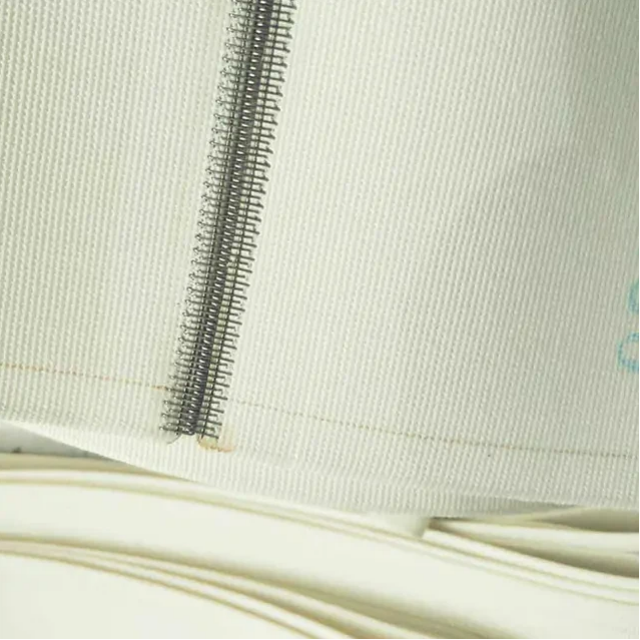
Woven belts are widely used in laundry ironing machines, where they support the continuous processing of flatwork items such as sheets, tablecloths, and uniforms.
In these applications, the belt must handle large volumes while maintaining consistent performance. It must also withstand repeated exposure to heat and moisture without losing its properties.
The quality of the belt directly affects the efficiency of the entire system. A reliable belt helps ensure smooth operation and consistent output.
In addition to ironing machines, woven belts are also used in feeding and folding systems within garment finishing lines. These systems rely on accurate and stable transport to position items correctly for the next stage of processing.
Although these applications may involve different configurations, the fundamental requirements remain the same: stability, durability, and smooth movement.
When it comes to replacing a woven belt, buyers often focus on technical specifications such as material type, width, and thickness. These factors determine whether the belt will fit the machine and perform as expected.
However, compatibility is not just about dimensions. The material must also match the operating conditions, including temperature, humidity, and workload.
Choosing the right combination of specifications helps ensure that the belt integrates properly into the system and delivers reliable performance.
Another important consideration is the construction of the belt. Endless belts provide a seamless surface, which can improve stability and reduce the risk of weak points.
Jointed belts, on the other hand, may offer easier installation but require careful alignment to ensure smooth operation.
Installation quality also plays a role in performance. Proper tensioning and alignment are essential for achieving the best results.
Different ironing systems have different requirements. Factors such as machine design, operating speed, and production volume all influence the ideal belt specification.
At iFeltek, we develop solutions tailored to specific applications. By understanding the working conditions of each customer, we can provide belts that match their needs more closely.
This approach helps improve performance and reduce the risk of compatibility issues.
Consistency is important not only in production but also in supply. Using belts with stable quality ensures that performance remains predictable over time.
Frequent variations in product quality can lead to uncertainty and disrupt operations. By maintaining consistent standards, iFeltek helps customers achieve more reliable results.
Belt Function | What Happens If Performance Is Poor | Effect on Production | Buyer Takeaway |
Transport stability | Uneven movement or slipping | Inconsistent finishing | Choose stable, durable belts |
Heat resistance | Material deformation | Frequent adjustments | Ensure high-temperature suitability |
Air permeability | Moisture retention | Slower drying | Look for breathable structure |
Durability | Rapid wear and tear | Increased downtime | Focus on long service life |
Surface consistency | Fabric distortion | Lower product quality | Maintain uniform belt condition |
A woven belt is not simply a moving component—it is a working surface that directly influences how textiles are handled, processed, and finished. Its performance affects transport stability, ironing quality, and overall production efficiency. By understanding its role within the system, buyers can make more informed decisions and avoid common issues related to inconsistent performance. At iFeltek, we focus on providing solutions tailored to ironing and laundry applications, helping customers achieve reliable and efficient operations with high-performance conveyor belt systems. If you are looking to improve your finishing line, contact us to learn more about suitable woven belt options.
1. What is the main function of a woven belt in an ironing machine?
It transports textiles smoothly through the machine while maintaining stability and consistent processing conditions.
2. How does a woven belt affect ironing quality?
It influences movement, alignment, and airflow, all of which impact how evenly garments are pressed and finished.
3. How long does a woven belt typically last?
Its lifespan depends on operating conditions, but high-quality belts designed for ironing applications generally last longer and require fewer replacements.
4. Can a worn woven belt affect machine performance?
Yes, it can cause misalignment, uneven feeding, and reduced efficiency, which may lead to lower product quality and increased downtime.
